
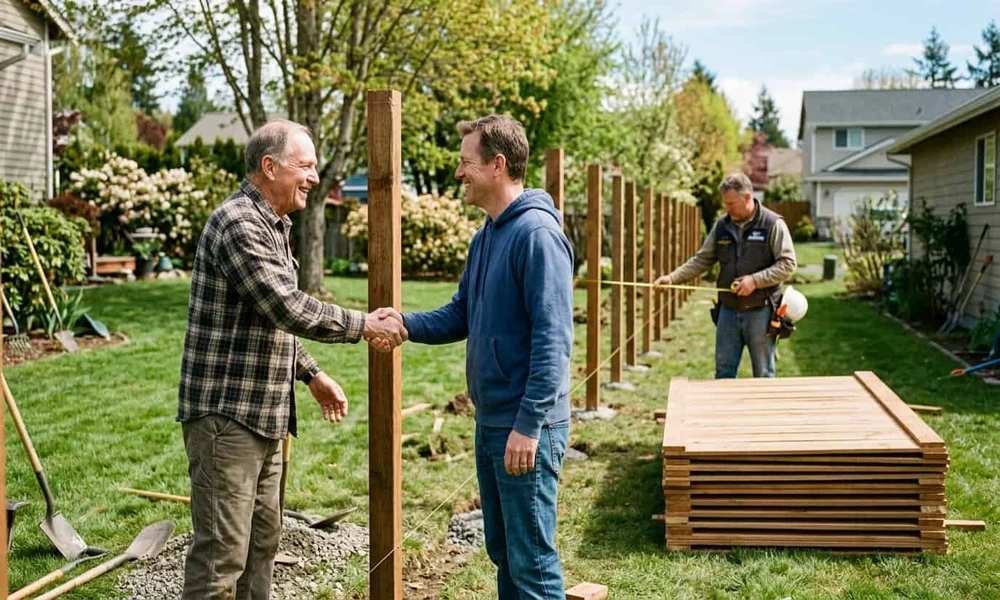
A fence can create a boundary dispute before the first post goes in. Homeowners researching fence installation Boise should establish the property line and settle any shared-fence arrangements with adjoining owners before construction begins. Boise requires a fence to stand entirely on the owner’s property or within an easement unless an agreement is made with the adjoining property owner.
Finding the Line
Ada County keeps the records that show where a line should fall. The Assessor’s office provides online access to records of survey, subdivision plats, and interactive maps. Surveyors file corner records with the Ada County Recorder. When a survey finds that a fence and a boundary disagree, Idaho law requires the recorded survey to describe the difference. Idaho Code 55-1904 also requires a surveyor to file a record of survey within 90 days when a survey discloses a material discrepancy with earlier surveys or sets monuments that were not previously monumented.
What Idaho Law Says About Shared Fences
Idaho’s fence statutes in Title 35 date back to 1885, and some still govern how adjoining owners share a partition fence. Idaho Code 35-103 addresses situations in which adjoining land is enclosed by one fence and a partition fence is needed to protect an owner’s interests. Under those circumstances, an owner can give written notice requiring the other party to build or arrange for half the fence. If that work is not completed within six months, the owner who gave notice may build the entire fence and seek half the cost, with a lien against the adjoining land. The statute does not establish an automatic cost-sharing obligation for every residential fence.
The statutes use rural wording such as hog-tight fences, so owners of town lots should read them alongside Boise’s code. The Idaho Farm Bureau’s plain-language summary says it is not legal advice and recommends an attorney for specific questions. Idaho Code 35-108 addresses fences mistakenly built in good faith on another person’s land and allows the builder to remove the fence within one year of discovering the mistake. Section 35-110 separately addresses a survey that establishes the boundary and gives notice requiring the mistaken fence to be removed within one year.
What a Written Agreement Should Cover
A signed one-page letter works as a starting point. It should list both owners’ names, the parcel numbers, and the date. It should also name these items:
- The exact line, shown with a survey or a sketch tied to marked corners.
- Whether the fence stands on the line or inside one owner’s lot.
- Height, material, and which side faces which yard.
- How the cost is split.
- Who maintains each section and who pays for storm repairs.
- Access for crews on both lots during construction.
Contractors build according to the owner’s instructions, so a written agreement helps document what both neighbors have approved. Keep a copy with the property records and permit paperwork.
Call 811 Before the Posts Go In
Idaho requires a call to 811 at least two business days and no more than ten business days before excavation. Idaho Power notes that locate tickets stay valid for 28 days, that a new locate is needed if work has not begun within 21 days, and that digging within 24 inches of marked lines must be done by hand. Digline, the call center that covers most of the state, operates from Boise. Utility marks show buried lines and say nothing about boundaries. A survey does that.
Idaho Code 55-2211 generally calls for a training course after a first violation. If a residential homeowner or tenant fails to notify 811 while excavating on their residence lot and damages an underground facility, the board must issue a written warning and educational materials. A second violation can bring a civil penalty of up to $1,000.
Petrified Forest Boise handles the builder permits and utility locations as part of installation, which removes the 811 scheduling from the owner’s list. Owners should confirm that both their name and the contractor’s name appear on the locate request.
Settling the Line Before the Posts
Fence disputes cost more than the fence itself. If a neighbor refuses to agree to a fence on or across the shared line, keep the proposed fence on your own property and consult an Idaho property attorney before relying on Title 35. Section 35-103 addresses partition-fence construction and cost-sharing under specific circumstances; it does not replace permission to use a neighbor’s land.