
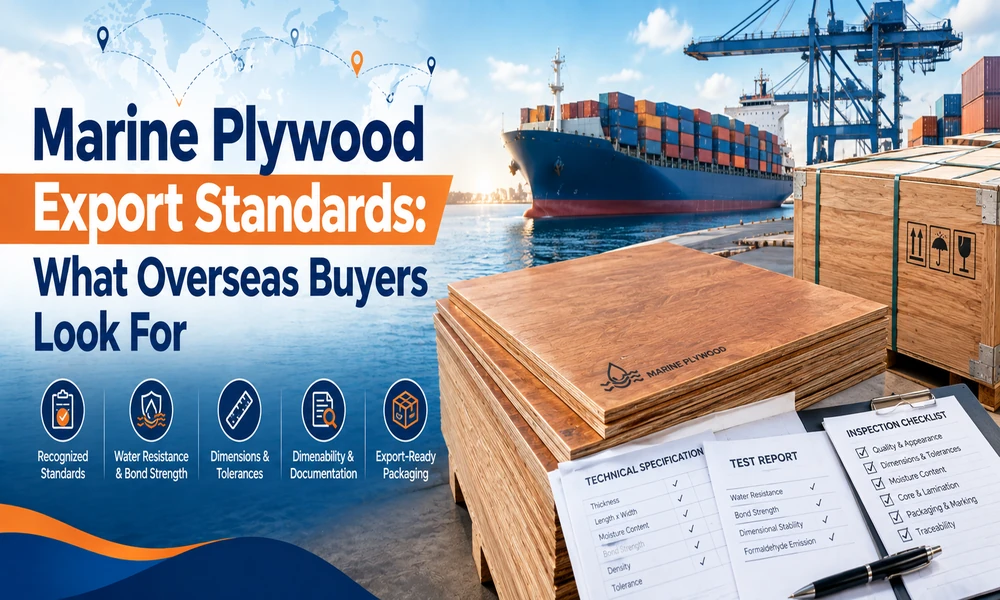
Selling marine plywood in export markets is about more than simply attaching the “export quality” tag on a sheet. International buyers often seek proof of the consistent manufacture of the plywood, its compliance with certain specifications, and its suitability for the purpose intended.
For industrial producers in India, IS 710 is the yardstick for marine plywood. Exporting purchasers can also call for international standard compliance,as in the case of IS 1088, or third-party certifications depending on the destination and the intended use.
Certification Comes First
For an export client assessing marine plywood, the first question that arises is which specification the product conforms to. Certification gives the buyer the leeway to evaluate the material without relying solely on the manufacturer’s word.
In this regard, it is important to note that the material supplied carries BS 1088 Lloyd’s certifications, which is an export- quality standard. This serves as an illustration of compliance with this standard by Austin Plywood, which exports to over 25 countries.
Consistency Matters in Each Batch
An overseas client ordering a full container of plywood is not evaluating a single sheet of plywood. He is concerned about ensuring that the same standards are met throughout all the products supplied. As a result, aspects such as the quality of the veneer, the core building process, and the maintenance of the thickness of the plywood all become essential. The available material highlights that the structural integrity of the core, a high degree of precision in the thickness, and certified production processes are the features that distinguish trustworthy plywood producers from cheap ones. For international procurement, the importance of this factor is even greater.
Marine Construction Should Be Consistent with the Claim
Marine plywood is a type that would be used in particularly wet environments, which means that foreign customers would care not only about the brand name but also about the features of the plywood used. The use of phenolic glue, the quality of the veneer and the type of core are the elements that determine how the final product behaves in wet conditions.
The comparison provided shows that Marine Grade plywood is manufactured using phenolic bonding and veneer with minimal voids suitable for various outdoor applications. The information on the manufacturing process is way more valuable than a descriptor saying that the plywood is waterproof.
International Procurement is Backed by Appropriate Documentation
Foreign customers also need proper documentation showing what they are going to pay for. This documentation may include certain certificate documents, technical specifications, and descriptions of the products, including their tests.
The available material indicates that the manufacturing quality, core integrity, glue, and thickness consistency can be regarded as parameters that are used for the evaluation of plywood brands. Using the information provided allows an international procurement team to accurately assess suppliers. Moreover, the type of product needed can easily be checked against specifications provided in advance.
Treatment and Application Requirements
Marine plywood can face different weather conditions and threats of mould, leaks, and decay in different locations of use. Therefore, the buyers need to pay attention to the treatment of the material in addition to the structural construction of the item.
According to the supplied data, the plywood may be treated to protect against such forms of spoilage as termites, borers, fungi, bacteria, and other forms of damage at the time of plywood evaluation,as long as such treatment exists. Specific treatment prescribed varies by end-use market and destination. Therefore, manufacturers should be making market-specific statements rather than generalising everywhere.
Expectations of International Buyers
Buyers should check for five things before making any order for export:
- what standards are relevant for the usage and destination of the product;
- what kind of certification the manufacturer possesses;
- what the item is made of;
- where the testing data can be found;
- if the document reflects the shipped product.
The same rules apply to manufacturers such as Royale Touche in India when exporting Marine Plywood. The quality of the item may be assessed according to its classification, construction, certification, and technical datasheet.
Conclusion
When looking for Marine Plywood, international buyers are looking for confirmation of the standards being respected at all production stages together with the compliance of the product itself. Certifications like BS 1088 may be a good reference to the quality of exported goods, whereas the construction information such as veneer quality, bonding, and core integrity may provide the answers to the suitability of the plywood to high-load applications.
No single label indicates that plywood is “export-grade” for all countries. One needs to check all the required conditions of the intended destination, confirm the certification, and check the documentation against the quality specifications.